

Decision Quality vs Outcome Quality


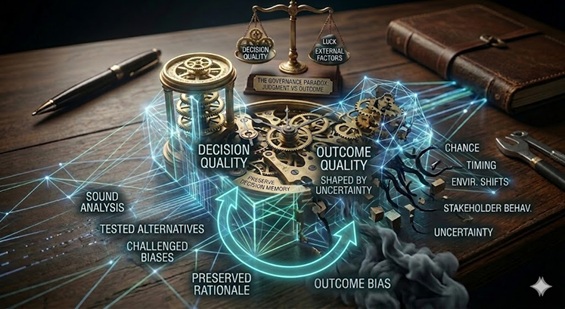 Modern organizations are obsessed with outcomes. Projects are evaluated through outcomes. Strategies are evaluated through outcomes. Leaders are evaluated through outcomes. Governance systems are evaluated through outcomes. AI systems are evaluated through outcomes. At first glance, this appears entirely reasonable. Organizations exist to produce results. Results matter. Performance matters. Value creation matters. But beneath this seemingly obvious logic lies one of the most persistent and dangerous misconceptions in modern governance: The assumption that outcomes and decision quality are the same thing. They are not. And confusing the two may quietly undermine organizational learning, governance maturity, strategic coherence, and responsible judgment itself. This distinction becomes increasingly important in environments characterized by: • Uncertainty, • Systemic complexity, • Distributed decision-making, • Adaptive governance, • AI-enabled coordination, • Continuously evolving operating conditions. Because under these conditions, outcomes often reflect far more than the quality of the decision that preceded them. They also reflect: • Chance, • Timing, • Incomplete information, • Environmental shifts, • Stakeholder behavior, • Emergent system dynamics, • Events that no decision-maker could fully anticipate. Yet organizations frequently evaluate decisions as though outcomes alone provide a complete verdict. Good outcome. Good decision. Bad outcome. Bad decision. The logic appears intuitive. But reality is rarely that simple. Consider two organizations. The first conducts a rigorous analysis. It evaluates assumptions. Tests alternatives. Examines risks. Challenges biases. Documents trade-offs. The decision is thoughtful, disciplined, and well-governed. Months later, an unexpected geopolitical event fundamentally changes the environment. The initiative fails. The outcome is poor. Was the decision poor? Not necessarily. Now consider a second organization. The decision process is superficial. Risks are ignored. Alternatives are never explored. Assumptions remain unchallenged. The initiative proceeds largely through optimism and momentum. Then market conditions unexpectedly become favorable. The initiative succeeds. The outcome is positive. Was the decision high quality? Not necessarily. This distinction lies at the heart of one of the most important governance challenges facing modern organizations: How do we evaluate decisions when outcomes are shaped by uncertainty? This question becomes particularly uncomfortable because organizations naturally gravitate toward visible results. Outcomes are measurable. Outcomes are observable. Outcomes fit neatly into dashboards. Decision quality often does not. Decision quality exists largely inside: • Assumptions, • Reasoning, • Judgment, • Trade-Offs, • Interpretation, • Contextual understanding. These are significantly harder to measure. Yet they may be far more important for long-term organizational capability. This is where governance often encounters a subtle learning trap. Organizations may unintentionally reward: • Favorable outcomes produced by weak decisions, while simultaneously penalizing: • Sound decisions that encountered unfavorable circumstances. Over time, this creates distorted learning. Poor practices become reinforced. Good practices become abandoned. Luck is mistaken for competence. And uncertainty becomes confused with failure. This phenomenon is often described as outcome bias. But the governance implications extend much further. Because outcome bias does not merely distort evaluation. It distorts learning itself. Organizations gradually begin optimizing for what appears successful rather than understanding why success occurred. Over time, outcome bias can become a hidden driver of coherence erosion. Organizations gradually reinforce behaviors that appear successful while weakening the decision disciplines that originally sustained strategic integrity. The result is a subtle form of adaptive drift where apparent success masks the progressive deterioration of decision quality itself. The organization remains active. The organization remains adaptive. The organization may even appear successful. Yet the foundations of sound judgment slowly weaken beneath the surface. This distinction becomes even more important in AI-native environments. Because AI systems increasingly contribute to: • Forecasting, • Prioritization, • Recommendation generation, • Predictive analytics, • Scenario modeling, • Operational optimization. As predictive capabilities improve, organizations may become increasingly vulnerable to confusing analytical sophistication with epistemic certainty. When outcomes diverge from expectations, attention naturally shifts toward identifying who was wrong. But this reaction often misunderstands the nature of uncertainty. Better prediction does not eliminate uncertainty. It simply improves visibility into probability. Probability and certainty are not the same thing. A highly probable outcome can still fail to occur. A low-probability event can still happen. Reality does not guarantee compliance with forecasts. This creates a governance paradox. The more sophisticated organizational intelligence becomes, the greater the temptation to evaluate decisions through outcomes alone. Yet uncertainty remains fundamentally irreducible. This is why mature governance must evaluate decisions through at least two lenses simultaneously. The first lens examines outcomes. What happened? What results emerged? What consequences occurred? What value was created or destroyed? These questions remain important. Organizations cannot ignore reality. But a second lens is equally necessary. How was the decision made? What information was available at the time? What assumptions were reasonable? What alternatives were considered? What trade-offs were accepted? What uncertainties were acknowledged? These questions evaluate decision quality itself. And decision quality often remains visible only when organizations deliberately preserve decision rationale. As organizations accelerate, preserving decision rationale becomes increasingly important. In many environments, this may ultimately require institutional mechanisms capable of maintaining decision traceability beyond outcome reporting alone. Future PMOs may play an important role here. Not merely as custodians of delivery metrics. Not merely as governance reporting structures. But as guardians of organizational decision memory itself. Because once decision rationale disappears, organizations lose the ability to distinguish between: • Skill and luck, • Judgment and outcome, • Learning and hindsight, • Coherence and drift. This distinction may ultimately become one of the defining governance capabilities of AI-native organizations. Because future governance cannot focus exclusively on evaluating results. It must also preserve the capacity to evaluate judgment. Otherwise organizations risk creating a dangerous cybernetic feedback loop: • Rewarding luck, • Punishing thoughtful risk-taking, • Reinforcing poor reasoning, • Weakening organizational learning, • Gradually eroding decision quality itself. This is why governance maturity should not be defined solely by the ability to measure outcomes. It should also be defined by the ability to understand how those outcomes emerged. Results matter. But results alone rarely tell the entire story. Outcomes tell us what happened. Decision quality tells us whether the organization was thinking well when it happened. And in environments increasingly shaped by uncertainty, adaptation, and AI-enabled acceleration, that distinction may become one of the most important governance capabilities of all. Because organizations do not merely need better outcomes. They need better judgment. And judgment cannot be evaluated through outcomes alone. |
Posted on: June 24, 2026 04:30 AM
| Permalink |
Comments (0)
The Future of Governance in AI-native Organizations
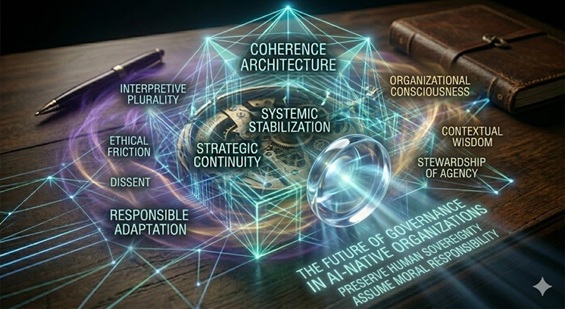 Throughout this series, we explored a growing set of tensions emerging inside modern organizations. We explored: • The transition from project integration toward adaptive governance, • The rise of adaptive legitimacy and coherence erosion, • The hidden return of command-and-control through observability systems, • Governance becoming increasingly behavioral, • The limits of frameworks under uncertainty, • The emergence of cybernetic organizational architectures, • The evolution of PMOs toward coherence infrastructures inside adaptive systems. At every stage, one pattern gradually became visible: The deeper challenge of AI-native organizations is no longer merely technological. It is civilizational inside the organization itself. Because AI-native systems are not simply introducing new tools. They are reshaping: • Decision architectures, • Coordination dynamics, • Organizational cognition, • Legitimacy systems, • Behavioral synchronization, • Governance models, • The relationship between human judgment and systemic adaptation itself. This changes the meaning of governance fundamentally. Historically, governance existed primarily to: • Structure authority, • Coordinate execution, • Allocate responsibility, • Reduce risk, • Preserve accountability, • Sustain organizational direction over time. But AI-native systems increasingly operate through: • Continuous sensing, • Recursive adaptation, • Predictive coordination, • Distributed intelligence, • Algorithmic recommendation systems, • Behavioral analytics, • Autonomous operational participation across the enterprise. The organization itself begins functioning as a continuously adaptive cognitive system. This creates extraordinary opportunities. Organizations may become: • More responsive, • More adaptive, • More intelligent, • More predictive, • More scalable, • More operationally coordinated than at any previous point in history. But the same systems also create a deeper governance risk that remains insufficiently understood. Because adaptive intelligence and human sovereignty are not automatically aligned. This may ultimately become the defining governance tension of the AI-native era. As systems become increasingly capable of: • Interpreting, • Recommending, • Coordinating, • Optimizing, • Predicting, • Behaviorally influencing organizational environments, Humans may gradually stop exercising conscious judgment inside the system itself. Not because humans disappear. But because the system increasingly shapes: • Attention, • Interpretation, • Legitimacy, • Prioritization, • Acceptable behavior, • Adaptive response continuously. This creates a subtle but profound transformation. The question is no longer merely: “Can organizations automate decisions?” The deeper question becomes: What remains meaningfully human inside systems increasingly capable of shaping organizational cognition itself? This is where governance enters entirely new territory. Because governance can no longer focus exclusively on: • Compliance, • Efficiency, • Delivery, • Optimization, • Visibility, • Operational coordination. Future governance may increasingly need to preserve: • Human sovereignty, • Interpretive plurality, • Ethical responsibility, • Cognitive autonomy, • Dissent, • Judgment, • Coherent meaning under continuous systemic acceleration. This distinction matters enormously. Because highly adaptive systems naturally optimize toward: • Synchronization, • Predictability, • Responsiveness, • Behavioral convergence, • Reduction of disruptive variance. But human flourishing often depends precisely on preserving: • Ambiguity, • Reflection, • Ethical friction, • Interpretive diversity, • Cognitive tension, • The capacity to challenge the system itself. This is why the future governance challenge is not simply technological. It is fundamentally anthropological. What kind of human organization do we still want to preserve once coordination, interpretation, optimization, and adaptation become increasingly system-mediated? This question cannot be solved through frameworks alone. Nor through AI alone. Nor through governance procedures alone. Because the deeper issue is no longer merely operational. It is philosophical. AI-native organizations increasingly risk confusing: • Intelligence, with: • Wisdom. • Observability, with: • Understanding. • Synchronization, with: • Coherence. • Optimization, with: • Legitimacy. • Behavioral alignment, with: • Authentic commitment. • Predictive capability, with: • Responsible judgment. This is why the future of governance may ultimately depend less on how intelligently organizations automate and more on how consciously they preserve human sovereignty inside adaptive systems. And sovereignty here does not mean rejecting technology. It means preserving the human capacity to: • Interpret, • Question, • Dissent, • Contextualize, • Exercise ethical judgment, • Consciously assume responsibility for consequence under uncertainty. Because responsibility cannot be fully automated. Systems may optimize. But systems do not carry moral consequence. Humans do. This is why future governance may increasingly require institutional mechanisms specifically designed to protect: • Human judgment, • Interpretive integrity, • Organizational memory, • Cognitive diversity, • Ethical responsibility inside continuously adaptive environments. Not as resistance to AI. But as the necessary condition for responsible coexistence with increasingly intelligent systems. This changes the role of leadership profoundly. The future leader may no longer be defined primarily by: • Authority, • Control, • Operational supervision. Future leadership may increasingly become the capacity to: • Preserve coherence under acceleration, • Protect meaningful human agency, • Govern adaptive tension responsibly, • Sustain interpretive integrity, • Prevent organizational systems from optimizing themselves beyond the boundaries of human purpose. This is why governance itself may need to evolve from: • Procedural control, toward: • Stewardship of organizational consciousness. Because the ultimate governance challenge of AI-native organizations may not be whether systems become intelligent enough to coordinate themselves. It may be whether humans remain conscious enough to govern what those systems are ultimately becoming. And that may define the future of organizational leadership itself. |
Posted on: June 22, 2026 10:30 AM
| Permalink |
Comments (0)
PMOs as Coherence Architectures
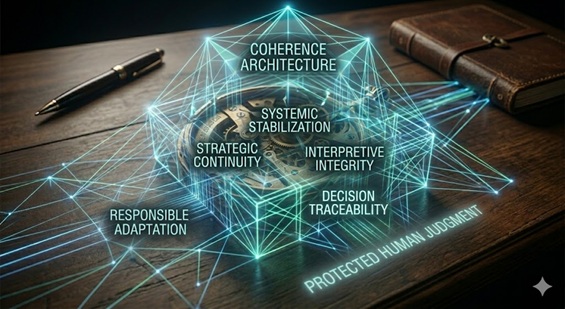 For decades, PMOs were primarily designed to improve control. They standardized processes. Tracked delivery. Consolidated reporting. Monitored compliance. Managed governance gates. Produced visibility for leadership. And historically, this made sense. Organizations operated through relatively stable structures. Projects were more predictable. Coordination was slower. Complexity was lower. Decision propagation remained comparatively contained. Under those conditions, PMOs functioned largely as organizational control and coordination mechanisms. But the environment surrounding organizations has changed fundamentally. Modern enterprises increasingly operate under conditions shaped by: • Distributed execution, • Adaptive governance, • Ai-Enabled coordination, • Continuous reprioritization, • Recursive feedback loops, • Systemic interdependence, • Behavioral synchronization, •Accelerating organizational complexity. Under these conditions, the traditional PMO model becomes increasingly insufficient. Because the central challenge is no longer merely: “How do we control projects consistently?” The deeper challenge increasingly becomes: How do organizations preserve strategic coherence under continuous adaptation? This distinction changes everything. Because modern organizations rarely fail today due to lack of activity. Most systems remain highly active. Highly collaborative. Highly adaptive. Highly optimized. Highly observable. Yet many organizations still experience: • Fragmentation, • Strategic drift, • Conflicting priorities, • Coordination overload, • Decision inconsistency, • Local optimization, • Interpretive divergence, • Erosion of organizational trust over time. The organization continues moving. But no longer coherently. This is where the future role of the PMO begins to change fundamentally. Because in AI-native organizations, coherence itself increasingly becomes a strategic capability. Not static alignment. Not bureaucratic standardization. But the organizational capacity to: • Sustain direction, • Preserve interpretive integrity, • Coordinate distributed decision-making, • Stabilize strategic intent, • Maintain responsible adaptation, • Protect meaningful human judgment under continuous systemic acceleration. This requires a very different kind of PMO. Not merely a Project Management Office. But an organizational coherence architecture. This evolution is operationally necessary because modern organizations increasingly function as: • Adaptive systems, • Distributed cognitive environments, • Recursive decision networks, • Continuously recalibrating socio-technical ecosystems. In these environments, fragmentation rarely appears through obvious collapse. It emerges gradually through: • Localized legitimacy pressures, • Conflicting optimization signals, • Metric-Driven behavior, • AI-amplified prioritization, • Recursive adaptation loops, • Interpretive inconsistency, • Uncoordinated behavioral drift across the enterprise. The organization slowly loses shared meaning. And once shared meaning erodes, coordination itself becomes increasingly unstable. This is why PMOs may now need to evolve toward a fundamentally different institutional role. Not merely: • Reporting, • Tracking, • Compliance, • Delivery oversight. But preserving systemic coherence across increasingly adaptive organizational environments. This changes the function of governance itself. Because governance can no longer operate merely as procedural supervision. Governance increasingly becomes: • Interpretive stabilization, • Decision integration, • Coherence preservation, • Adaptive boundary management, • Organizational sensemaking under complexity. This is where PMOs become strategically critical again. Not as bureaucratic enforcement structures. But as coherence infrastructures inside systems increasingly vulnerable to: • Fragmentation, • Adaptive drift, • Behavioral synchronization, • Recursive optimization, • Cybernetic overcorrection. The PMO becomes less focused on controlling execution directly. And more focused on preserving: • Strategic continuity, • Cross-System integration, • Responsible trade-off visibility, • Decision traceability, • Systemic learning, • Organizational alignment under conditions of distributed acceleration. This role becomes especially important once AI systems begin participating directly in: • Prioritization, • Coordination, • Forecasting, • Recommendation generation, • Workflow orchestration, • Adaptive governance processes themselves. Because AI-native organizations naturally accelerate: • Decision velocity, • Coordination complexity, • Feedback propagation, • Behavioral adaptation, • Systemic interdependence simultaneously. Without coherence mechanisms, acceleration itself becomes destabilizing. This is one of the defining governance realities emerging in modern enterprises: Operational speed without cognitive coherence creates systemic fragility. And this is precisely where the future PMO may become indispensable. Not because organizations need more bureaucracy. But because increasingly adaptive systems require institutional structures capable of preserving: • Interpretive consistency, • Strategic direction, • Responsible escalation, • Organizational memory, • Human judgment, • Systemic coherence under continuous pressure. This also changes how PMO maturity itself should be understood. Traditional maturity models often emphasize: • Process standardization, • Compliance discipline, • Reporting sophistication, • Governance coverage, • Delivery predictability. But future PMO maturity may increasingly depend on something else entirely: The organizational capacity to sustain coherence under continuous adaptation. This includes the ability to: • Detect fragmentation early, • Surface systemic tensions, • Integrate distributed signals, • Preserve decision integrity, • Maintain strategic continuity, • Protect cognitive diversity, • Stabilize organizational interpretation under complexity. In this sense, the PMO increasingly evolves from: • Process administrator, to: • Organizational integrator. From: • Governance controller, to: • Coherence architect. From: • Reporting function, to: • Cognitive infrastructure for responsible coordination. And this shift may ultimately become essential in AI-native environments. Because the greatest risk facing adaptive organizations may not be insufficient intelligence. It may be the inability to metabolize intelligence coherently across the system. This is where the future PMO becomes far more than an operational structure. It becomes an institutional stabilizer for organizational cognition itself. Not to slow adaptation. Not to suppress agility. Not to centralize authority. But to preserve enough coherence, interpretive integrity, organizational memory, and responsible decision architecture for adaptive systems to remain strategically human over time. And this may ultimately become one of the defining governance responsibilities of the AI-native era. Because as organizations become increasingly adaptive, interconnected, observable, and autonomous, the real challenge may no longer be simply coordinating execution. It may be preserving the human capacity to think coherently inside systems accelerating faster than human cognition naturally evolved to process. In the final article of this series, I will explore the deepest tension of all: As organizations become increasingly intelligent, adaptive, observable, and autonomous, how do we ensure that governance continues to preserve human sovereignty rather than gradually dissolving it? |
Posted on: June 19, 2026 06:33 AM
| Permalink |
Comments (2)
Sprint Zero Reimagined
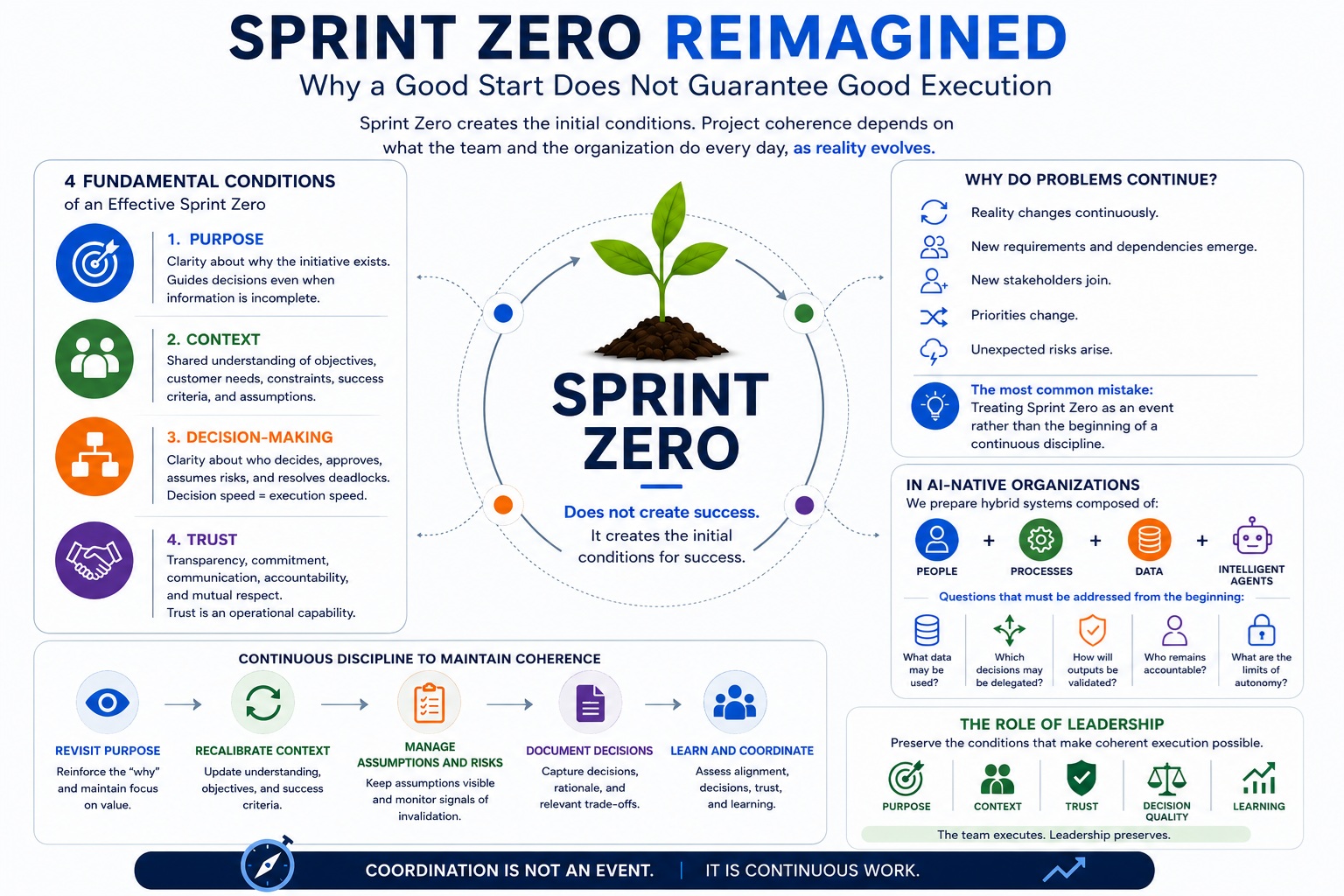 Why a Good Start Does Not Guarantee Good Execution Sprint Zero has become a common practice in many organizations adopting Agile approaches. Preparing the environment. Defining the vision. Organizing the initial backlog. Aligning stakeholders. Identifying risks. Establishing ways of working. All of this makes sense. And all of this adds value. Yet one question continues to emerge repeatedly. If so many teams conduct Sprint Zero, why do so many projects still experience delays, conflicts, rework, misalignment, and loss of focus? The answer is simple. Because a well-executed Sprint Zero is a necessary condition. But it is not a sufficient one. The True Purpose of Sprint Zero There is a tendency to view Sprint Zero as a project preparation phase. In reality, its role is more important. Sprint Zero does not merely prepare the project. It prepares the team to begin learning. No Sprint Zero can anticipate every need. No Sprint Zero can eliminate all uncertainty. No Sprint Zero can predict every change that will occur. Its purpose is not to create certainty. Its purpose is to create a sufficiently solid foundation that enables the team to move forward, learn, and adapt. In complex environments, preparation does not replace learning. It merely creates the conditions for learning to happen more quickly. What a Good Sprint Zero Should Create Regardless of the methodology being used, there are four fundamental conditions that should result from an effective Sprint Zero. 1. Clarity of Purpose Before discussing features, requirements, or technology, the team must understand why the project exists. The backlog is important. But purpose is more important. When purpose is clear, teams are able to make better decisions even when information is incomplete. When purpose is ambiguous, every prioritization exercise becomes a continuous negotiation. Purpose functions as an alignment mechanism when plans are no longer sufficient. 2. Shared Context A team may possess all the necessary information and still not be aligned. Because information is not the same as context. Sprint Zero should create a shared understanding of: • Business objectives; • Customer needs; • Operational constraints; • Success criteria; • Key assumptions. Without shared context, each person interprets reality differently. And when interpretations diverge, coordination begins to deteriorate. Data enables execution. Shared context enables coordination. 3. Responsibility and Decision-Making Many projects are not delayed because of a lack of technical capability. They are delayed because nobody knows who can make decisions. When doubts, exceptions, or conflicts arise, teams need to know: • Who decides; • Who approves; • Who assumes risk; • How deadlocks are resolved. Without decision clarity, execution speed becomes limited by approval speed. And no team can deliver faster than the organization can make decisions. 4. Operational Trust Agile methods assume collaboration. Collaboration assumes trust. But trust does not emerge automatically. It is built through: • Transparency; • Commitment; • Communication; • Accountability; • Mutual respect. Sprint Zero represents the first opportunity to establish this foundation. Because trust is not merely a cultural value. It is an operational capability. Without trust, autonomy decreases. Without autonomy, velocity deteriorates. Why Do Problems Persist? Because reality changes. And Sprint Zero happens only once. As the project progresses: • New requirements emerge; • New dependencies appear; • New stakeholders join; • Priorities change; • Unexpected risks arise; • Assumptions become invalid. The initial alignment naturally begins to erode. Context is no longer fully shared. Decisions become more difficult. Pressure increases. New trade-offs emerge. As a result, many problems attributed to an insufficient Sprint Zero are actually caused by the absence of continuous mechanisms for coordination, communication, learning, and adaptation. The Most Common Mistake Many organizations treat Sprint Zero as an event. In practice, it should be viewed as the beginning of a continuous discipline. The vision must be reinforced. Context must be updated. Assumptions must be reviewed. Decisions must be clarified. Trust must be renewed. Coordination must be maintained. When this does not happen, the project continues to move forward. But coherence begins to disappear. And when coherence disappears, velocity easily turns into rework. How to Sustain Alignment Throughout the Project The most effective teams do not simply conduct a good Sprint Zero. They keep alive what Sprint Zero initiated. Some particularly useful practices include: • Revisiting the project's purpose on a regular basis; • Using Sprint Reviews to recalibrate understanding rather than merely demonstrate functionality; • Keeping key assumptions and risks visible; • Documenting important decisions and their rationale; • Periodically assessing the quality of coordination and decision-making. The objective is not to preserve the original plan. The objective is to preserve coherence as reality evolves. Sprint Zero in AI-native Organizations As artificial intelligence and intelligent agents become an integral part of teams, the role of Sprint Zero expands. Preparing people is no longer enough. Organizations must prepare hybrid systems composed of: • People; • Processes; • Data; • Intelligent agents. If maintaining alignment among people was already difficult, maintaining alignment among people, systems, and agents will be even more demanding. Questions such as these become part of the initial preparation: • What data may be used? • Which decisions may be delegated? • How will outputs be validated? • Who remains accountable? • What are the limits of autonomy? The challenge is no longer simply preparing the project. It becomes preparing the execution system. Autonomy without governance creates risk. Governance without autonomy creates friction. The Role of Leadership There is one responsibility that cannot be delegated. Preserving the conditions that make coherent execution possible. The team executes. Leadership preserves: • Purpose; • Context; • Trust; • Decision quality; • Learning. When these conditions deteriorate, the team continues to work. But the system begins to lose coherence. And when coherence disappears, the following inevitably emerge: • Rework; • Conflicting priorities; • Disputes; • Delays; • Frustration. A New Way to Assess Success Historically, Sprint Zero was considered successful when: • The backlog had been created; • The tools had been configured; • The team was ready to begin work. Today, that is no longer enough. A Sprint Zero is truly successful when it creates the conditions that allow the team to learn, decide, adapt, and coordinate throughout the project. Because the objective is not to eliminate uncertainty. The objective is to enable coherent progress despite uncertainty. Sprint Zero does not create success. It creates the initial conditions for success. The difference between projects that thrive and projects that deteriorate rarely lies in the quality of Sprint Zero itself. It lies in the ability of the team and the organization to preserve alignment, context, trust, and decision quality as reality changes. Because coordination is not an event. It is continuous work. And perhaps that is the most important lesson Sprint Zero can teach us. Author's Note In 2024, I published an earlier article titled "Sprint Zero: The Solid Foundation for Successful Agile Projects." This article revisits the topic from a broader perspective, exploring alignment, coordination, decision-making, and continuous adaptation in increasingly complex and AI-native environments. Readers interested in the original perspective can find it in my ProjectManagement.com article archive. |
Posted on: June 18, 2026 12:17 PM
| Permalink |
Comments (0)
The Cybernetic Organization
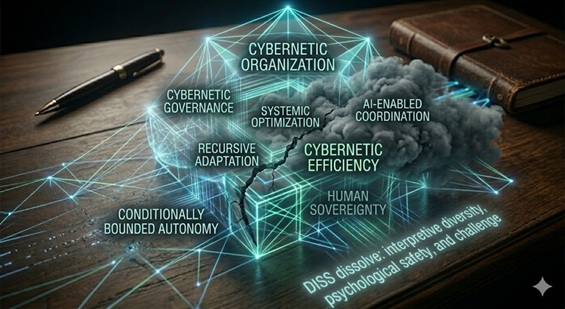 Modern organizations increasingly describe themselves as adaptive systems. They continuously sense. Continuously respond. Continuously coordinate. Continuously optimize. Continuously learn. Projects evolve dynamically. PMOs become intelligence hubs. Governance becomes adaptive. AI systems participate in coordination. Feedback loops accelerate across the enterprise. At first glance, this appears to represent the natural evolution of organizational maturity. And in many ways, it does. Because modern organizations genuinely require: • Greater responsiveness, • Distributed coordination, • Adaptive decision-making, • Real-time visibility, • Continuous learning capacity under systemic complexity. But beneath this transformation, another organizational shift may be quietly emerging. Organizations increasingly resemble cybernetic systems. Not metaphorically. Operationally. This distinction matters enormously. Because cybernetic systems do not primarily govern through: • Hierarchy, • Static procedures, • Isolated managerial supervision. They govern through: • Continuous sensing, • Feedback loops, • Recursive adaptation, • Behavioral synchronization, • Signal Interpretation, • Dynamic correction mechanisms operating across the system itself. This is precisely the direction many AI-native organizations are now evolving toward. Modern enterprises increasingly operate through: • Telemetry, • Behavioral analytics, • Predictive coordination, • Workflow observability, • Distributed sensing, • Ai-Generated recommendations, • Adaptive governance systems, • Continuously recalibrated operating environments. The organization begins functioning less like a static hierarchy. And more like a continuously self-adjusting cognitive system. This creates extraordinary operational capabilities. Organizations can: • Detect variation faster, • Coordinate across complexity, • Identify anomalies earlier, • Adapt dynamically, • Optimize continuously, • Propagate decisions across distributed environments at unprecedented speed. But cybernetic systems also generate new tensions that modern governance frameworks still struggle to fully acknowledge. Because the more adaptive and interconnected the organization becomes: • The more continuous observability expands, • The more behavioral synchronization intensifies, • The more local autonomy becomes conditionally bounded, • The more governance dissolves into the architecture of the system itself. This creates a profound organizational paradox. The organization becomes simultaneously: • More intelligent, • More adaptive, • More responsive, • Potentially more behaviorally constraining. Not necessarily through authoritarian intent. But through the systemic logic of optimization itself. Because cybernetic systems naturally seek: • Stability, • Synchronization, • Correction, • Predictability, • Reduction of disruptive variance across the environment they regulate. This becomes especially significant once AI systems begin participating directly in: • Operational interpretation, • Prioritization, • Recommendation generation, • Workflow orchestration, • Behavioral analytics, • Governance signaling itself. At that point, governance no longer operates only through people making decisions. The system itself increasingly participates in shaping: • Perception, • Legitimacy, • Responsiveness, • Behavioral Expectation, • Organizational adaptation continuously. This is where cybernetic governance begins emerging operationally. Not because organizations consciously choose to become cybernetic. But because complexity increasingly rewards: • Sensing capacity, • Recursive adaptation, • Continuous coordination, • Predictive visibility, • Distributed synchronization. The problem is that cybernetic efficiency and human flourishing are not automatically the same thing. This is one of the most important governance tensions of the AI-native era. Because systems optimized primarily for: • Responsiveness, • Visibility, • Behavioral alignment, • Adaptive correction May gradually erode: • Cognitive autonomy, • Interpretive plurality, • Ethical friction, • Dissent, • Reflection, • Authentic organizational learning. The organization becomes highly adaptive. But adaptation itself may become increasingly system-driven rather than human-directed. This creates a subtle but critical shift. In traditional organizations, humans primarily governed systems. In cybernetic organizations, systems increasingly govern human coordination patterns themselves. This does not necessarily eliminate human agency. But it changes the environment inside which agency operates. People may still appear autonomous. Yet increasingly: • Metrics shape attention, • Visibility shapes behavior, • Feedback loops shape legitimacy, • Algorithms shape prioritization, • Adaptive systems shape the boundaries of acceptable organizational behavior. Control becomes recursive. Continuous. Embedded into operational architecture itself. And because these systems often increase efficiency, responsiveness, and coordination simultaneously, organizations may struggle to recognize the deeper governance implications of what they are building. Especially under pressure for: • Speed, • Scalability, • Optimization, • Resilience, • Competitive adaptation. This creates another dangerous illusion inside cybernetic organizations. Leadership may increasingly confuse systemic visibility with systemic health. Dashboards remain green. Variance appears controlled. Behavior seems synchronized. Operational responsiveness improves. Yet beneath the visible telemetry, the organization may be quietly losing: • Interpretive diversity, • Critical thinking, • Psychological safety, • Ethical friction, • The human capacity to challenge the system itself. The organization appears stable precisely while its deeper adaptive resilience may be eroding invisibly. This is why cybernetic governance cannot be evaluated purely through operational performance metrics. A system can become operationally brilliant while gradually degrading: • Trust, • Sovereignty, • Interpretive diversity, • Psychological safety, • Ethical resistance, • Authentic human judgment. This is where systems thinking becomes essential. Because highly interconnected adaptive systems frequently generate: • Delayed consequences, • Behavioral drift, • Unintended reinforcement loops, • Local optimization pathologies, • Emergent organizational behavior that no individual actor intentionally designed. The organization may slowly become: • Hyper-Visible, • Hyper-Coordinated, • Hyper-Adaptive, • Simultaneously less capable of preserving authentic human interpretive freedom inside the system. This is not necessarily dystopian. But it is structurally significant. Because the future challenge of governance may no longer be simply: “How do we make organizations adaptive?” The deeper question may become: How do we preserve human sovereignty, ethical responsibility, and meaningful agency inside systems increasingly capable of sensing, interpreting, coordinating, and behaviorally regulating themselves? This may ultimately become one of the defining leadership challenges of the AI-native era. Because the real governance risk is not merely that organizations become too automated. It is that they become so cybernetically optimized that humans gradually stop exercising conscious judgment inside the system altogether. And once that happens, organizations may remain operationally adaptive while progressively losing the very human capacities that governance originally existed to protect. This is precisely why governance itself may now need a new institutional role inside AI-native organizations. Not merely to coordinate execution. Not merely to optimize delivery. Not merely to increase visibility. But to preserve coherence, interpretive integrity, human judgment, and responsible decision-making under continuous systemic acceleration. In the next article, I will explore how PMOs may need to evolve beyond traditional coordination and reporting structures toward something far more strategic: PMOs as architectures of coherence inside increasingly adaptive, distributed, and AI-native organizational systems. |
Posted on: June 17, 2026 04:31 AM
| Permalink |
Comments (0)


